Work backwards from the time you want to eat
A Christmas dinner timetable is easiest to write backwards. Start with the time you want plates on the table, then subtract each step: carving, resting, cooking. The turkey goes in first, so its start time decides the rest of the morning. Write the times down, and stick the sheet where everyone in the kitchen can see it.
- Choose a serving time and write it at the bottom of a sheet of paper.
- Work out the turkey’s cooking time from its packaging. Use the instructions that came with your bird first.
- Add time for the turkey to rest out of the oven and to carve it. Your recipe will give a resting time.
- Count back from the serving time: serving time, minus carving and resting, minus cooking time, gives the time the turkey goes in. Then add time to preheat the oven.
- Fit everything else around it. Roast potatoes, stuffing and pigs in blankets usually go in while the turkey rests, because the oven is free.
Turkey cooking times: what the Food Standards Agency says
The Food Standards Agency (FSA) says to check the retailer’s instructions on the packaging first. If there are no cooking instructions, its guidance is, in an oven preheated to 180ºC (160ºC fan, 350ºF or Gas Mark 4):
- Allow 45 minutes per kg plus 20 minutes for a turkey that weighs under 4.5kg
- Allow 40 minutes per kg for a turkey that weighs between 4.5kg and 6.5kg
- Allow 35 minutes per kg for a turkey that weighs over 6.5kg
The FSA also says: “The cooking guidelines will be based on a bird that is not stuffed.” It advises: “Cook the stuffing in a separate roasting tin, not inside the turkey.”
Source: Food Standards Agency, Christmas food hygiene, checked 17 November 2026. A crown, a boned joint or a bird with its own instructions will be different: follow the packaging.
A worked example: a 4kg whole turkey, dinner at 2pm
Example only. The cooking time uses the FSA rule above for a 4kg unstuffed whole turkey: 45 minutes × 4 + 20 minutes = 200 minutes (3 hr 20 min). The 40 minutes to rest and carve is our own example allowance, not an FSA figure: use the resting time in your recipe. Your packaging comes first.
| Time | What happens (example) |
|---|---|
| Before 10am | Oven on to preheat (allow the time your oven needs). Turkey out of its wrapping, into the tin. |
| 10am | Turkey in (3 hr 20 min for 4kg, from the FSA rule). Stuffing stays out: it cooks in its own tin later. |
| Late morning | Peel and prep anything not done the day before. Check the timetable for the sides. |
| 1:20pm | Check the turkey is cooked (see below). Out of the oven to rest. The oven is now free for the sides. |
| 1:20pm to 2pm | Turkey rests, then is carved just before 2pm. Roast potatoes, stuffing and pigs in blankets: count each recipe’s time back from 2pm. Anything that needs longer than the rest shares the oven with the turkey for a while, so keep a shelf free. Veg and gravy on the hob. |
| 2pm | Dinner on the table. |
Write your own version on a sheet with three columns: the time, what goes in or comes out, and which shelf or hob ring it uses. That last column is what stops two trays fighting for one shelf at 1pm.
Is it cooked? The FSA check
The FSA says to make sure the bird is steaming hot and cooked all the way through: cut into the thickest part and “check that none of the meat is pink and that any juices run clear”. In a whole bird, “the thickest part of the meat is the area between the leg and the breast”.
If you have a temperature probe, the FSA says the thickest part of the meat needs to reach one of these combinations:
- 60°C for 45 minutes
- 65°C for 10 minutes
- 70°C for 2 minutes
- 75°C for 30 seconds
- 80°C for 6 seconds
Two more FSA points worth knowing: “Do not wash raw turkey before cooking”, and “Do not defrost your turkey at room temperature”.
Defrosting: count back days, not hours
A frozen turkey needs planning days ahead. The FSA says to check the packaging first, and if there are no instructions: “In a fridge, allow around 10-12 hours per kg.” It also says: “A typical large turkey weighing 6-7kg could take as much as 4 days to fully defrost in the fridge.” For the 4kg example, that rule gives 40 to 48 hours, so it would need to go in the fridge on Wednesday 23 December 2026 (morning) at the latest to be ready for Christmas morning.
Make room in the fridge early. The FSA says: “Check your fridge is set at 5°C or below.” It also suggests you “keep raw meat and fish covered on the bottom shelf of your fridge”.
Prep the day before
Christmas Eve is the time to take jobs off Christmas morning. None of these need special skills:
- Peel the potatoes, carrots and parsnips, and trim the sprouts and any other green veg.
- Make the stuffing and shape it, ready to cook in its own tin.
- Wrap the pigs in blankets and keep them covered in the fridge on a tray.
- Lay the table, find the carving knife and the serving dishes, and put a label on each dish saying what goes in it.
- Write the timetable out and stick it on a cupboard door.
Oven juggling
- List every dish that needs the oven and the temperature its recipe asks for. If two dishes want different temperatures, they cannot share the oven at the same time without a compromise.
- The turkey’s rest is the gap you plan around. Once it is out and resting, the oven is free for roast potatoes, stuffing and pigs in blankets, and you can change the temperature to suit them.
- Use the hob for what it does well: boil potatoes before roasting, and cook sprouts, carrots and gravy on the hob in the last half hour.
- The microwave is a spare oven for the pudding and for reheating a gravy you made ahead.
- If you have a slow cooker or an air fryer, give it one job (red cabbage, or a tray of potatoes or stuffing) to free a shelf.
Leftovers
From the FSA’s guidance: leftovers can be eaten cold if they have been cooked properly, “cooled, and put in the fridge within two hours”. “Eat leftovers within 48 hours or freeze them if you think this won’t be possible.” And when reheating, “you should only ever reheat once”.
Sources: Food Standards Agency, Christmas food hygiene and Cooking your food, both checked 17 November 2026. This guide is general information, not a substitute for the instructions on your food.
Want the pages ready to fill in?
Everything above works on a sheet of paper. If you would rather have it laid out, the UK Christmas Dinner Planner is an 18-page printable (A4 and US Letter) with a menu planner, guest list with dietary needs, seating plan, shopping list by aisle, a 7-day countdown to Christmas Day, a turkey cooking-time helper, a worked oven timetable and a blank work-backwards timetable, a running order, a leftovers plan with freezer labels, and place and menu cards.
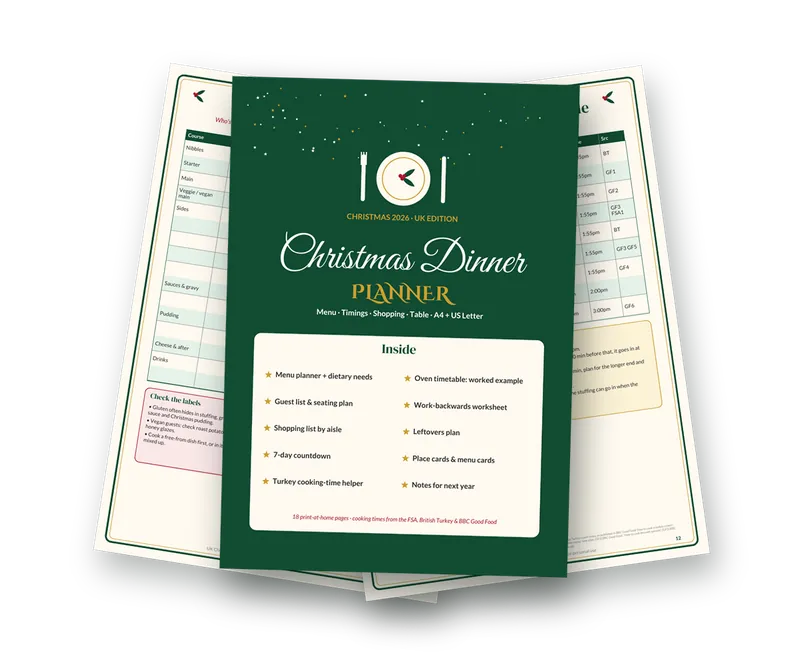
UK Christmas Dinner Planner
Menu, shopping and an oven timetable for the big day · £3.99 · A4 + US Letter PDFs
More guides
How to set a Christmas gift budget and track presents (UK)
Set one Christmas total, split it per person, and track what is bought, wrapped and posted. With Black Friday tips and Royal Mail 2026 posting dates.
Read the guide →Christmas party games for adults (UK office ideas)
Free Christmas party games you can run in a UK office or pub with paper, pens and a phone timer. Includes a 30-minute plan and a short quiz.
Read the guide →