The shape of a good family escape room
Every home escape room has the same three parts. A short story gives a reason to hurry (the workshop is locked, the sleigh is stuck). A few puzzles each give one piece of an answer: a number, a letter or a word. A final lock needs all the pieces together. When the pieces fit, something happens: a door opens on paper, a box is unlocked, or a treat appears.
Keep it to one final lock. Children lose interest when every puzzle needs its own padlock and they cannot see how close they are. A sheet where they write each answer as they get it shows progress, and that keeps a 6-year-old going.
Puzzles that work for ages 6 to 12
- Letter codes: A=1, B=2, or a letter wheel where each letter moves a few places. Younger children need a grown-up to read the code key with them.
- Counting in a picture: how many stars, with snowflakes or bells as tricks. Quick for little ones, and older ones like spotting the tricks.
- Picture sums: two presents make 6, so one present is 3. It feels like a secret code, but it is simple maths.
- A maze with letters on the right path. Letters in dead ends keep older children honest.
- Patterns: star, bell, star, bell, then what? The missing picture turns into a letter.
- A word search where the leftover letters spell a word. Best for readers, so pair younger children with an adult.
- A cut-up picture or jigsaw that shows a number when it is put back together.
Mix the types. A team with a 6-year-old and a 10-year-old does best when each child has a puzzle they can lead.
Timing, hints and fairness
- Plan on about 45 to 60 minutes for six or seven puzzles. Allow longer for younger children, and stop for a snack if energy drops.
- Write two hints for every puzzle before you start: a small nudge, then a bigger one. Offer the first after about five minutes of being stuck.
- Test every puzzle yourself and write the answers on a separate sheet. A puzzle with two possible answers ruins the final lock.
- Play it as a trail (each answer leads to the next hiding place) or put every puzzle on the table at once. Bigger groups do better with the table.
- Keep scissors and small parts such as split pins with an adult when little ones are playing.
A free 3-puzzle escape room you can make in 10 minutes
You need paper, a pen and five paper stars. Tell the children the snowman has locked the hot chocolate tin and left three clues.
- Clue 1, the code: write 19-14-15-23 on a card, with “A=1, B=2, C=3…” underneath. The answer is SNOW.
- Clue 2, the count: hide five paper stars around one room. The number of stars found is the first number of the lock: 5.
- Clue 3, the sum: write “🎁 + 🎁 = 8. What is 🎁?” using drawn presents. The answer is 4.
Final lock: the children say the magic word SNOW and the code 5-4. Then the hot chocolate comes out. Change the word, the stars and the sum to make your own version.
Want it ready to print?
If you would rather not make the puzzles yourself, the Christmas Escape Room for Families & Kids has a story, seven puzzles that lead to one final lock, hint cards, an answer key and certificates, in A4 and US Letter. You can run the free version above with what you already have.
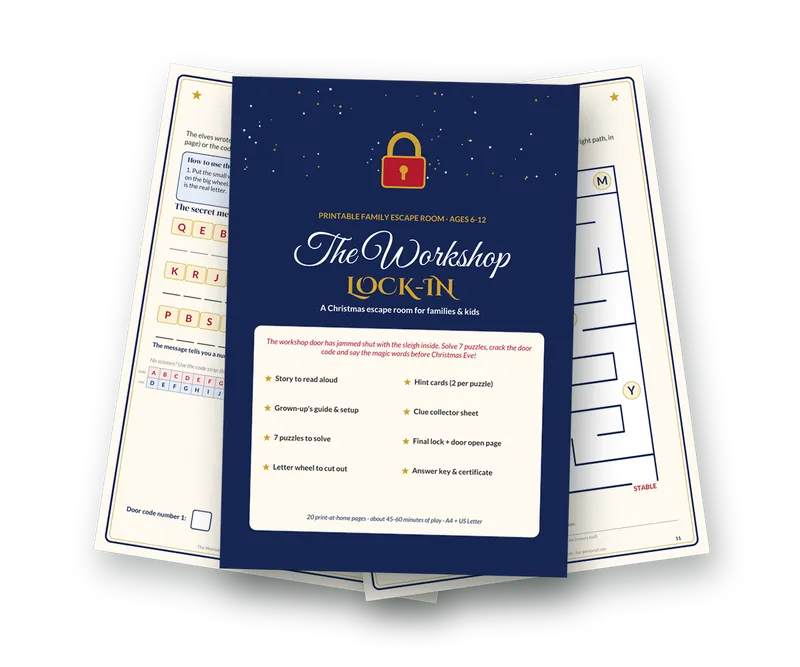
Christmas Escape Room for Families & Kids
Crack the code before Christmas Eve, ages 6–12 · £4.99 · A4 + US Letter PDFs
More guides
Christmas countdown activities for families: 24 free ideas (UK 2026)
Christmas countdown activities for UK families: 24 free ideas. Advent Sunday in 2026 is 29 November. Most need no special kit or shopping.
Read the guide →Christmas Eve box ideas (UK): 30 things to put in a Christmas Eve box
Christmas Eve box ideas for UK families: 30 things to put in a Christmas Eve box, from pyjamas and hot chocolate to books, a film and budget ideas.
Read the guide →