Three rules that keep a tracker honest
- Three habits at most, for the first month. A page of twelve empty rows is a menu, not a target.
- Each habit should be something you can do on an ordinary day, in a way you can tick yes or no. “Read one page” works. “Read more” does not.
- Never miss twice if you can help it. One missed day is a blip. Two in a row is the start of a new pattern. If you miss, do the smallest version the next day and tick that.
Pair each habit with something you already do: stretch after you put the kettle on, or write a single line in a notebook after you clean your teeth. The existing habit is the reminder, so you do not have to rely on motivation at 10pm.
When to start
1 January is a busy day, and it is not magic. If you want the new year to begin with a streak already going, start in mid-December. If you would rather rest first, start on the first Monday after New Year, or on the day your life is quiet again. An undated tracker is useful here, because the page does not care whether you begin on the 1st.
What to put on the page
- A month grid with one row per habit and one box per day. Tick, cross, or leave blank. Blank is more honest than back-filling a week you have forgotten.
- A “done” count at the end of the row, out of 28, 29, 30 or 31, depending on the month. February needs the leap-year case: 2028 is a leap year, 2027 is not.
- A weekly review: what went well, what got in the way, and whether one habit should be made smaller.
Look at the page at the same time each day. A tracker in a closed app you never open, or a beautiful notebook in a drawer, will not do the work.
15 habit ideas you can start at home, for nothing
These are suggestions, not a programme, and they are not medical advice. Pick three at most. Swap any that do not fit.
- Make the bed before breakfast.
- Drink a glass of water when you first get up.
- A ten-minute walk, even around the block.
- Put your phone to charge in another room at a set time.
- Write three lines about the day, in any notebook.
- Read one page of a book you already own.
- Stretch for two minutes after the kettle boils.
- Prepare tomorrow’s bag or clothes before you sit down in the evening.
- Clear the sink before you go to bed.
- A no-spend day, once or twice a week, with food you already have.
- Message one person you have been meaning to reply to.
- Stand up, and look out of the window, between meetings or episodes.
- Five minutes of tidying a single surface, not the whole house.
- Write down what you spent today, in pounds, before you open an app for fun.
- Lights out at a time you choose, with a 15-minute margin rather than a perfect streak.
A weekly review that takes five minutes
- Which habit was easy? Keep it as it is.
- Which habit was a struggle? Make it smaller for seven days, or move it to a different time.
- Did you miss two days in a row? Write down what got in the way, once, and start again the next morning.
- Do not add a fourth habit until three have felt ordinary for a month.
If you want the pages already drawn, the 2027 Habit Tracker is an 18-page printable with 12 undated monthly grids (ten habit rows each), a 365-dot year page, a weekly review, a 30-day challenge and 40 habit ideas. It is undated, so it does not expire if you start late. The rules and the 15 ideas above are free, and they are enough to start with a sheet of paper tonight.
If money is one of the habits you care about, the UK Budget Spreadsheet 2027 keeps planned against actual spending in pounds, with a Christmas gift tab for the end of this year.
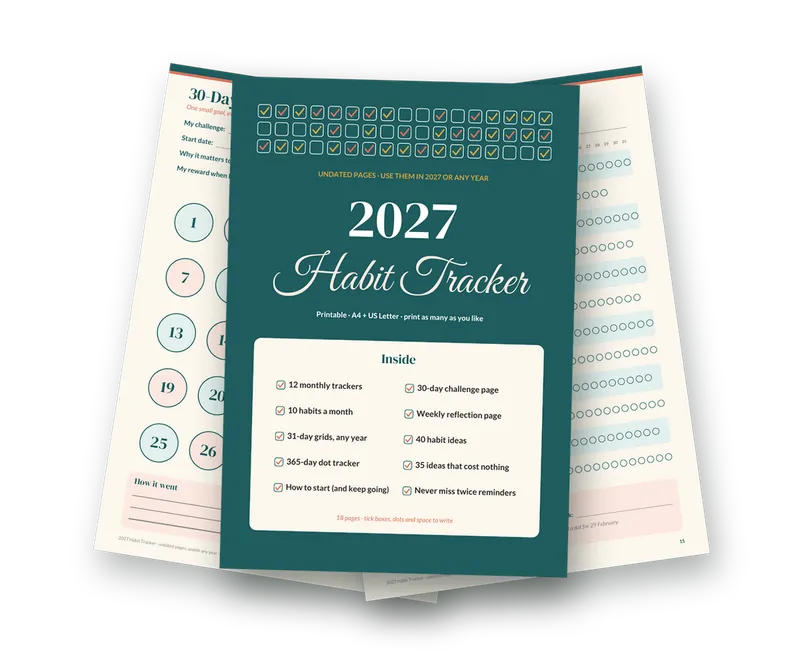
2027 Habit Tracker (undated)
Start any month. Never goes out of date · £3.49 · A4 + US Letter PDFs